
Does Your Workout Repeat Your Work Posture?
Most of us think of exercise as the antidote to a long day at a desk. Sit all day, then "undo" it at the gym, on the bike, or on the course. It's a tidy story — and it's only partly true.
The less comfortable question is this: what if the activity you're using to counteract your desk job is actually asking your spine to hold the same shape it held all day?
The shape we hold without noticing
A typical desk posture involves a forward-leaning trunk, rounded shoulders, and a flexed lower back — flexion meaning the spine curves forward, away from its natural extension. Hours of this can leave certain muscles overworked and others underused, and many people report feeling stiff, achy, or "locked" by the end of the day.
It's worth being careful here: forward-flexed posture is one contributor to discomfort among many, not a single, universal explanation for back pain. Pain is influenced by a mix of factors — movement variety, strength, stress, sleep, prior injury, and plain individual variation. Posture is part of the conversation, not the whole conversation. If you have back pain, start here with a quick quiz to narrow down the possible cause: structural, emotional, or digestive.
Where it gets interesting: sport doesn't always break the pattern
Here's the insight worth sitting with: several of the sports people turn to for exercise put the spine in a strikingly similar position to the one it held at the desk.
- Cycling — especially on a road or aggressive-fit bike — puts the rider in sustained trunk flexion, often for an hour or more.
- Golf — the setup position alone involves forward bend at the hips and spine, repeated over and over through the swing.
- Hockey — the skating stance is a flexed, forward-leaning posture sustained through most of a shift.
None of these sports are "bad" for you, and none of them are the cause of anyone's back pain by themselves. But if your workday is spent in flexion and your workout is also spent in flexion, your body may get very little exposure to the opposite end of its range—extension— over the course of the day.
That's the real question to ask yourself: does your workout repeat your work posture, or does it offer your spine something different?
Why variety matters more than any single "fix"
Spines, like most joints, tend to do better with a variety of positions and loads over the course of a day rather than a narrow, repeated range. If flexion dominates both your work and your recreation, introducing some deliberate extension — gently and appropriately for your own body — is a reasonable idea to explore, ideally with guidance from a qualified professional if you have any pain or history of injury.
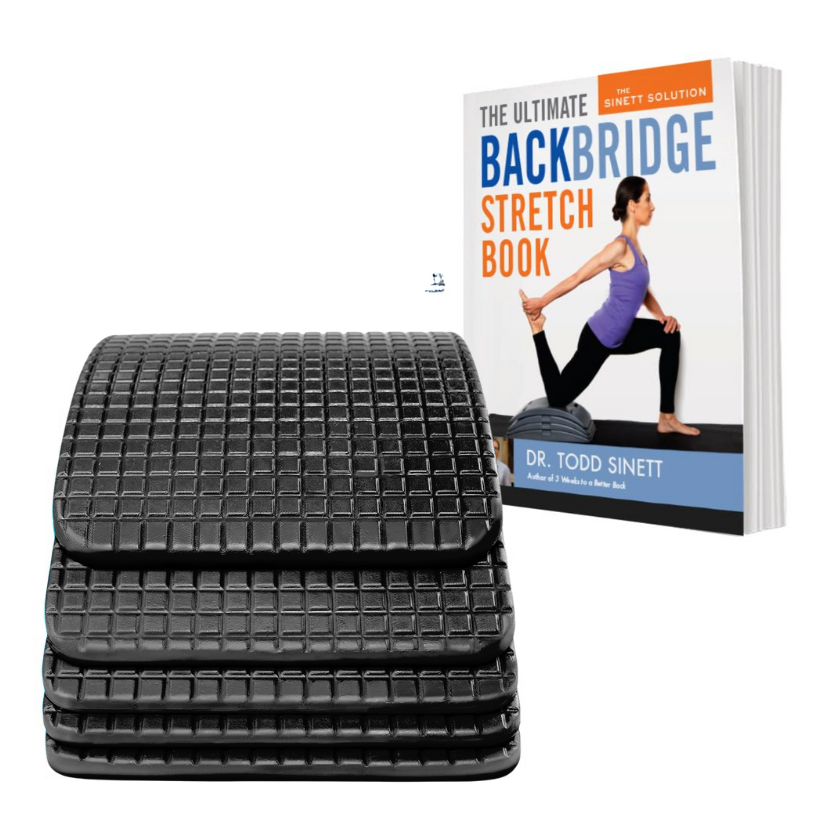
This is where a tool like a Backbridge (or any gentle back-extension device) can fit in — as one optional piece of a broader mobility routine, not a stand-alone solution and not a device that "realigns" your spine. No single tool corrects a spine or reverses years of postural habit. What gentle, controlled extension can offer is a counterbalance: a few minutes where the back experiences a different position than the one it's held all day. That's a modest, sensible role, and it's worth treating it as exactly that.
What else actually matters
If flexion-dominant sport and flexion-dominant work are stacking up, extension work is only one piece of the picture. A few other things worth thinking about:
- Bike fit. Saddle height, reach, and handlebar position all affect how much sustained flexion a rider's spine is under. A professional bike fit can sometimes reduce unnecessary flexion without sacrificing performance.
- Golf mechanics. Setup posture, spine angle at address, and swing technique are frequently addressed by coaches and physiotherapists who specialize in golf — small technical changes can meaningfully change the load on the low back.
- Strengthening. A resilient back generally benefits from strength across multiple planes of movement, not just flexibility or extension work in isolation. Core, hip, and posterior-chain strength all play a role.
- Professional evaluation. If pain persists, worsens, radiates, or doesn't respond to changes in posture and movement variety, that's a signal to see a physician, physical therapist, or other qualified clinician — not to keep experimenting alone. Persistent pain deserves an actual diagnosis, not just posture troubleshooting.
The takeaway
Exercise doesn't automatically reverse the posture you have held all day — sometimes it repeats it. The useful move isn't to declare any one sport or position "bad," but to take stock of your day as a whole: how much time is your spine spending in flexion, across work and play, and is there room to introduce some genuine variety — including gentle extension — as one part of a broader, sensible mobility routine?
If pain is part of your story, that variety is worth pursuing alongside good bike fit, sound golf mechanics, real strengthening work, and a professional evaluation — not instead of them.