
Why Yoga Blocks Fall Short — and What to Use Instead for Deeper, Safer Stretching
Discover why yoga blocks may be limiting your practice — and how the Backbridge yoga prop delivers progressive stretching, better back pain relief, and safer flexibility for all levels.
The Health Benefits of Yoga (And Why Your Prop Matters)
Yoga is one of the most effective practices you can add to your weekly health routine. Through posture-based movement — known as asanas — yoga reduces stress, improves mobility, builds flexibility, and supports healthy spinal alignment and posture.
But here's what most practitioners overlook: the yoga prop you use can make or break your progress.
"People dedicate time to aerobic exercise and strength training but aren't working on their flexibility as much as they should be, which can be detrimental to a healthy back and body," says Dr. Todd Sinett, a New York-based chiropractor and applied kinesiologist. "Practices like yoga are vital in helping one's range of motion."
The Problem with Traditional Yoga Blocks
Yoga blocks are a staple prop — used for balance, support, and reducing the risk of overstretching. But they come with real limitations that most yogis don't realize until their progress plateaus.
Dr. Sinett explains: "The blocks are a strict rectangle that can be flimsy and unreliable. They can also inhibit your ability to deepen your stretches because they are limited in height. Essentially, you will plateau at a certain stretch and no longer reap the benefits of yoga."
Because yoga blocks are rigid and flat, they're not shaped to the contours of the human body — which can create discomfort and actually restrict your range of motion over time.
A Better Yoga Prop: The Backbridge
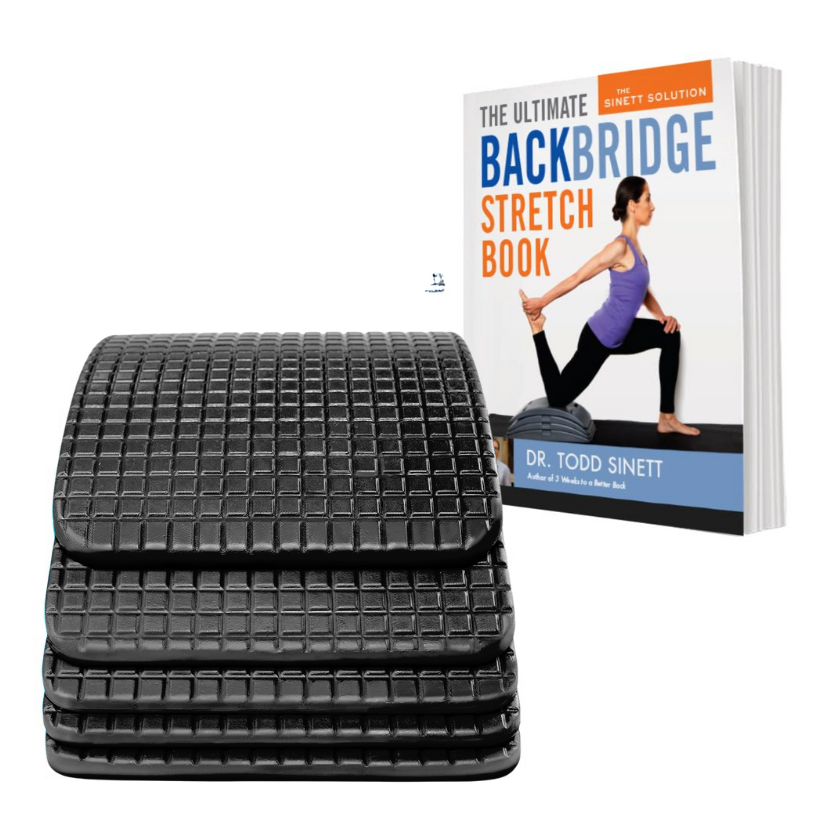
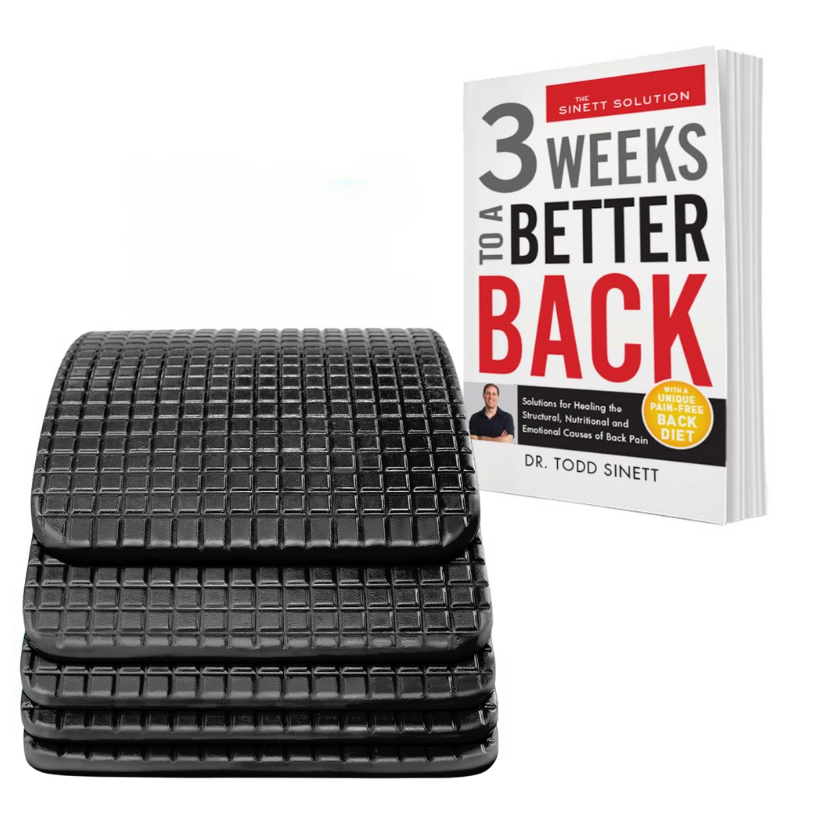
The Backbridge is a contoured yoga prop designed to replace the traditional yoga block — offering superior support, comfort, and versatility for practitioners at every level.
Unlike a standard block, the Backbridge:
- Conforms to your body's natural curves, hitting multiple touchpoints for safer, more comfortable stretching
- Offers five height levels (ranging from 2" to 7"), allowing for truly progressive stretching — meaning your body can safely reach new levels of flexibility over time
- Supports balance-focused postures by adding stability and adjustable difficulty
- Reduces injury risk by allowing you to adjust on days of tightness or soreness
"The Backbridge offers more stability, comfort, and achieves progressive stretching — stretching that allows your body to reach new levels in your practice," says Dr. Sinett.
How to get the most out of yoga without injury: five of our favorite asanas with the Backbridge.
Asana #1: Anjaneyasana (Crescent Lunge)
Kneel on the highest point of the Backbridge and step your right foot forward, bending your leg at 90 degrees (your knee should be directly over your ankle). Place your hands on top of your right knee or raise your arms overhead with your biceps next to your ears. Hold this pose for several rounds of breath and repeat on the other side. Level 1 is suggested for the deepest stretch, offering cushion for the knee cap as well as increased stability, which ensures more effective posture. Adding levels decreases the depth of the lunge and the amount of opening in the hip flexor, making the stretch easier for those who need modification.

Asana #2 Bhujangasana (Cobra Pose)
Lying face down over the Backbridge with your belly button near the highest point, place your hands in front of you and do half a push-up so that your upper torso is elevated, but your pelvis still has contact with the Backbridge. Look straight ahead or raise your eyes to the ceiling and hold for several breaths, then slowly lower yourself down and repeat. This stretch really works your lumbar extenders and lower back while stretching and lengthening the core (abdominals). The higher the Backbridge level you use, the easier the stretch will be.

Asana #3 Baddha Konasana (Bound Angle or Butterfly Pose)
Sit on the Backbridge and bring your feet in as close as possible. Place the soles of the feet together, letting the knees slowly drop open towards the mat. You can gently push down on your thighs with your elbows or on your lower legs with your forearms to increase the stretch. From here, hinge forward at the hips and grasp your feet, maintaining length in the spine. Continue to fold forward over your thighs as far as you can, eventually bringing your forehead to the ground in front of your feet.
Hold for 15-30 seconds.


Asana #4 Ardha Matsyendrasana (Half Lord of The Fishes Pose)
Sit on the Backbridge with your legs straight out in front of you. Bend your knees and bring your left foot under your right leg to the outside of your right hip, laying the left leg on the mat. If this is too much for your hips, you can extend your left leg out straight along the mat in front of you. Step your right foot over the left thigh, placing it just outside of your left thigh so that the knee is pointing to the ceiling. With a straight arm, place your right hand on the Backbridge just behind your right buttock. Bending your left arm, twist your torso to the right and place the outside of your left elbow on the outside of your right knee. Inhale and lengthen your torso. Exhale and deepen the twist. Repeat for several breaths and then switch legs and twist to the opposite side.

Asana #5 Supta Virasana (Reclining Hero Pose)
Move the Backbridge behind you so that you are sitting just in front of the short edge. Begin to lower your back toward the Backbridge by leaning onto your hands, then your forearms and elbows. Novice practitioners may remain here or continue reclining onto the Backbridge. The higher levels of the Backbridge will generate a more intense back bend but will create less pressure in the knees. You can rest your hands on the backs of your heels or angle them out on the sides of your torso, palms up. Stay in this pose for up to 2 minutes.

FAQ: Yoga Props and Back Health
Can yoga help with back pain? Yes. Yoga strengthens the muscles that support the spine, improves flexibility, and promotes healthy posture — all of which contribute to reduced back pain over time.
Are yoga blocks bad for you? Yoga blocks aren't inherently harmful, but their flat, rigid shape doesn't conform to the body. This can limit the depth of stretches and cause discomfort. A contoured prop like the Backbridge offers a safer, more progressive alternative.
What is progressive stretching in yoga? Progressive stretching means gradually increasing your range of motion over time by adjusting the height and angle of your prop — rather than staying at one fixed level. The Backbridge is specifically designed to support this approach.
Is the Backbridge good for beginners? Absolutely. The adjustable levels allow beginners to start gently and progress at their own pace, while reducing the risk of injury.
Find more Backbridge yoga poses, flow classes, and expert instruction in The Backbridge Yoga Book.